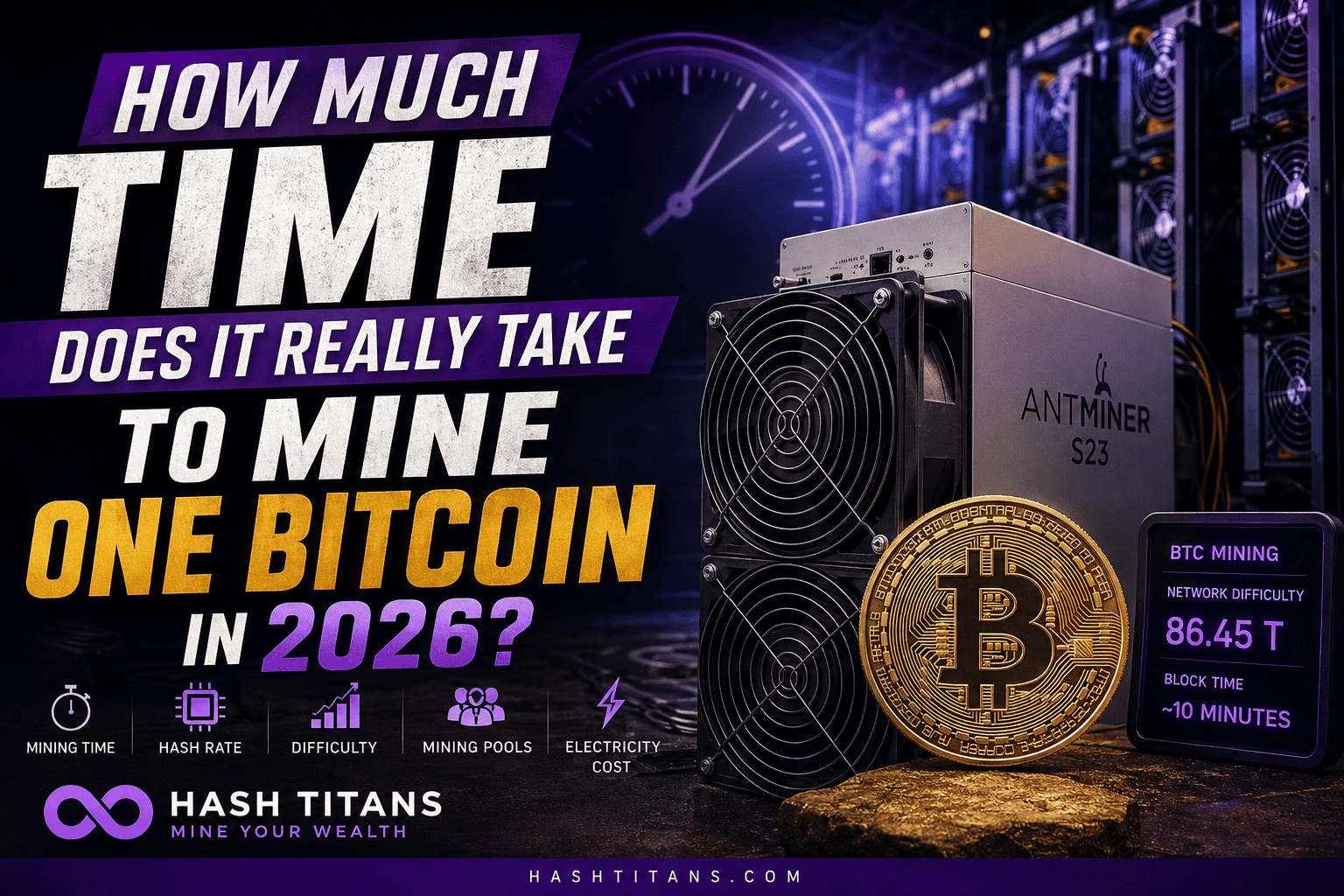

How Much Time Does It Really Take to Mine One Bitcoin in 2026?
Bitcoin remains the world’s largest and most valuable cryptocurrency, attracting investors, technology enthusiasts, and miners from around the globe. One of the most frequently asked questions by beginners is, “How much time does it really take to mine one Bitcoin in 2026?” While the question seems straightforward, the answer depends on several important factors, including your mining hardware, network difficulty, mining method, electricity costs, and even luck.
Unlike the early days of Bitcoin, when anyone could mine coins using a personal computer, today’s mining landscape is highly competitive. Specialized ASIC miners now dominate the network, performing trillions of cryptographic calculations every second. As more miners join the network, the difficulty of finding a valid Bitcoin block continues to increase, making it much harder for individuals to mine Bitcoin on their own.
In this comprehensive guide, we’ll explain exactly how Bitcoin mining works, what determines the time required to mine one Bitcoin, and how professional mining hardware compares to hobby devices. You’ll also learn how mining pools influence payouts, why network difficulty changes every two weeks, and which ASIC miners offer the best performance in 2026.
Whether you’re considering purchasing your first Bitcoin miner or expanding an existing mining operation, this guide will help you understand the realities of modern Bitcoin mining.
- How Bitcoin Mining Works
- What Determines Mining Time?
- Can One Person Mine One Bitcoin?
- Bitcoin Mining Difficulty Explained
- Understanding Hash Rate
- Mining Pools vs Solo Mining
- Best ASIC Miners for 2026
- Is Mining Still Profitable?
- Frequently Asked Questions
- Final Thoughts
How Does Bitcoin Mining Work?
Bitcoin mining is the process of validating transactions and adding new blocks to the Bitcoin blockchain. Every transaction made on the network must be verified before it becomes a permanent part of the distributed ledger.
To accomplish this, miners use specialized hardware to solve complex mathematical puzzles through a process known as Proof of Work (PoW). The first miner to find the correct cryptographic hash earns the right to add the next block to the blockchain and receives the block reward along with transaction fees.
Today’s Bitcoin network is secured by millions of ASIC mining machines operating worldwide. These machines collectively generate an enormous amount of computational power, making Bitcoin one of the most secure decentralized networks ever created.
If you’re interested in exploring professional mining hardware, browse our collection of Bitcoin ASIC Miners, featuring machines designed for home miners and commercial mining farms alike.
What Determines How Long It Takes to Mine One Bitcoin?
There isn’t a single answer because several variables work together to determine how quickly Bitcoin can be mined. Even miners using identical hardware may experience different results depending on network conditions and the mining method they choose.
1. Hash Rate
Your miner’s hash rate is one of the biggest factors affecting mining speed. A higher hash rate means your hardware can perform more cryptographic calculations every second, increasing the likelihood of discovering a valid Bitcoin block.
Modern ASIC miners measure performance in terahashes per second (TH/s), while the largest commercial mining farms operate at petahash and exahash scales.
2. Network Difficulty
Bitcoin automatically adjusts its mining difficulty approximately every 2,016 blocks, or about every two weeks. As more miners join the network and total hash rate increases, the difficulty rises to maintain an average block time of around 10 minutes.
This automatic adjustment ensures that new Bitcoins are released at a predictable rate, regardless of how much mining power joins the network.
3. Mining Hardware
The type of mining hardware you use dramatically affects your mining performance. CPUs and GPUs are no longer practical for Bitcoin mining because they cannot compete with purpose-built ASIC miners.
For example, an entry-level hobby miner has only a tiny fraction of the computational power of a professional ASIC capable of producing hundreds of terahashes per second.
4. Mining Pool or Solo Mining
Whether you mine alone or join a mining pool has a significant impact on how often you receive rewards. Solo miners compete independently for the entire block reward, while pool participants combine their hash power and receive smaller, more consistent payouts based on their contribution.
5. Luck
Even with identical equipment, luck still plays a role in Bitcoin mining. Finding a valid block is based on probability, meaning one miner may discover a block sooner than expected while another may wait much longer despite having similar hardware.
Can One Person Mine One Bitcoin?
Yes—but the practical answer depends on your hardware and expectations.
Technically, anyone with compatible mining equipment can participate in the Bitcoin network. However, successfully mining an entire Bitcoin block on your own has become extremely difficult due to the enormous amount of global computing power securing the blockchain.
Large mining farms often operate thousands of ASIC miners simultaneously, giving them a much higher probability of discovering blocks. Individual miners using a single machine face much lower odds, which is why many choose to participate in mining pools.
Mining pools distribute rewards proportionally among participants, allowing individual miners to earn smaller but more frequent Bitcoin payouts instead of waiting months or years for a successful solo block.
Short Answer: How Long Does It Take?
The honest answer is that there is no fixed amount of time required to mine one Bitcoin. The duration depends on:
- Your ASIC miner’s hash rate
- The total Bitcoin network hash rate
- Current mining difficulty
- Whether you mine solo or in a pool
- Your share of the mining pool
- Bitcoin block rewards and transaction fees
For most individual miners, earning the equivalent of one Bitcoin is typically achieved gradually through mining pool payouts over an extended period rather than by independently discovering an entire block.
Why ASIC Miners Matter
If your goal is serious Bitcoin mining, investing in efficient ASIC hardware is essential. Modern miners deliver dramatically higher hash rates and better energy efficiency than older generations, helping maximize mining performance while controlling electricity costs.
HashTitans offers a wide selection of Bitcoin ASIC miners, including powerful models from leading manufacturers for both home users and commercial mining operations.
In the next section, we’ll explain Bitcoin mining difficulty, hash rate measurements, and why these two factors have the greatest influence on how long it takes to mine one Bitcoin in 2026.
Bitcoin Mining Difficulty Explained
One of the biggest factors affecting how much time it takes to mine one Bitcoin is Bitcoin mining difficulty. Even if you own one of the fastest ASIC miners available in 2026, increasing network difficulty can significantly reduce the amount of Bitcoin you earn over time.
Bitcoin’s mining difficulty is a measurement of how hard it is to find a valid block on the blockchain. The Bitcoin protocol automatically adjusts this difficulty every 2,016 blocks, which is approximately every two weeks.
The purpose of this adjustment is to keep Bitcoin’s average block creation time close to 10 minutes, regardless of how much mining hardware is connected to the network.
As more miners join the Bitcoin network, the combined hash rate increases. To compensate, the network raises the mining difficulty so that new blocks continue to be produced at roughly the same pace. If miners leave the network and the total hash rate decreases, Bitcoin automatically lowers the difficulty to maintain balance.
This self-adjusting system is one of Bitcoin’s most important innovations because it keeps the currency predictable, secure, and decentralized.
Why Does Mining Difficulty Increase?
Mining difficulty generally rises because more people and companies invest in increasingly powerful ASIC miners. Every time additional computational power joins the network, Bitcoin becomes more competitive.
Several factors influence mining difficulty, including:
- Growth of industrial mining farms
- Release of faster ASIC miners
- Lower electricity prices in mining regions
- Bitcoin price appreciation
- Improved mining efficiency
When Bitcoin prices increase, more miners enter the market, increasing competition and driving mining difficulty even higher.
If you’re considering upgrading your hardware, browse our latest collection of Bitcoin ASIC miners featuring efficient models designed for modern mining operations.
Understanding Hash Rate
If mining difficulty determines how hard it is to find a Bitcoin block, your hash rate determines how many attempts your mining hardware can make every second.
A hash is a cryptographic calculation performed by your mining machine while searching for the correct solution required to validate the next Bitcoin block.
The more hashes your miner performs every second, the greater your chances of earning mining rewards.
Hash Rate Units Explained
| Unit | Meaning | Hashes Per Second |
|---|---|---|
| KH/s | Kilohash | 1,000 |
| MH/s | Megahash | 1 Million |
| GH/s | Gigahash | 1 Billion |
| TH/s | Terahash | 1 Trillion |
| PH/s | Petahash | 1 Quadrillion |
| EH/s | Exahash | 1 Quintillion |
Modern Bitcoin mining machines typically operate in terahashes per second (TH/s), while the Bitcoin network itself is measured in exahashes per second because of its enormous total computational power.
Why Hash Rate Matters
The higher your miner’s hash rate, the greater your probability of solving Bitcoin blocks or contributing valuable work to a mining pool.
For example, a hobby miner capable of producing only a few gigahashes per second has virtually no chance of competing with modern ASIC miners capable of generating hundreds of terahashes every second.
Today’s most advanced mining hardware performs trillions of calculations every second while maintaining impressive energy efficiency.
Real-World Hash Rate Comparison
| Hardware | Typical Hash Rate | Suitable for Bitcoin? |
|---|---|---|
| CPU | Very Low | No |
| Gaming GPU | Low | No |
| NerdMiner | Educational Only | Lottery Mining |
| Older ASIC Miner | 50–100 TH/s | Yes |
| Modern ASIC Miner | 200–500+ TH/s | Excellent |
This comparison highlights why ASIC miners dominate Bitcoin mining today. Their specialized hardware is optimized exclusively for SHA-256 calculations, allowing them to outperform general-purpose computers by an enormous margin.
How ASIC Miners Reduce Mining Time
If your goal is to mine Bitcoin efficiently, choosing the right ASIC miner is one of the most important decisions you’ll make.
Modern ASIC miners combine extremely high hash rates with improved power efficiency, enabling miners to perform more work while reducing electricity costs.
Some of the most popular categories include:
- Home Bitcoin miners
- Commercial mining hardware
- Hydro-cooled ASIC miners
- Air-cooled ASIC miners
- Low-power Bitcoin miners
Explore our complete range of Bitcoin ASIC miners to compare specifications, power consumption, and hash rates.
Examples of Professional Bitcoin Miners
HashTitans offers a variety of ASIC miners suitable for different mining goals. Here are several examples:
- Bitmain Antminer S19 Pro 95TH — A reliable ASIC miner for home and small-scale operations.
- Bitmain Antminer S19 Hydro 158TH — Improved cooling and higher efficiency for demanding environments.
- Bitmain Antminer S23e Hydro — Built for high-performance commercial Bitcoin mining.
- NerdOctaxe Gamma — A compact option for enthusiasts exploring Bitcoin mining hardware.
- Gamma Turbo Bitcoin Miner — Designed for users seeking greater performance with efficient operation.
Can Faster ASIC Miners Mine One Bitcoin Faster?
Yes but it’s important to understand how mining rewards work. (Bitmain)
A faster ASIC miner increases your share of the network’s total hash rate, improving your probability of earning Bitcoin. However, no machine can guarantee that you’ll mine an entire Bitcoin within a fixed period because rewards depend on network difficulty, competition, and whether you mine solo or in a pool.
For most miners, joining a reputable mining pool results in smaller but more consistent payouts rather than waiting for the unlikely event of discovering a full block independently.
Key Takeaways
- Bitcoin mining difficulty changes approximately every two weeks.
- Higher network difficulty generally means longer mining times.
- ASIC miners dramatically outperform CPUs and GPUs.
- Hash rate is one of the most important factors affecting mining speed.
- Mining pools provide more predictable earnings than solo mining for most users.
- Modern, energy-efficient ASIC miners improve long-term mining performance.
Final Thoughts: How Much Time Does It Really Take to Mine One Bitcoin in 2026?
As we’ve explored throughout this guide, there is no single answer to the question, “How Much Time Does It Really Take to Mine One Bitcoin in 2026?” The time required depends on a combination of factors, including your ASIC miner’s hash rate, the Bitcoin network’s mining difficulty, electricity costs, whether you mine solo or through a mining pool, and overall network competition.
For most individual miners, earning the equivalent of one Bitcoin is a gradual process achieved through consistent mining pool payouts rather than discovering an entire block independently. While solo mining remains possible, the odds of finding a Bitcoin block with a single machine are extremely low due to the enormous computational power securing the Bitcoin network.
If you’re serious about Bitcoin mining, investing in efficient and reliable ASIC hardware is one of the most important decisions you can make. Modern miners deliver significantly higher hash rates and better energy efficiency than older generations, helping maximize your mining potential while keeping operating costs under control.
At HashTitans, we offer a carefully selected range of Bitcoin ASIC miners for beginners, enthusiasts, and professional mining operations. Whether you’re looking for an entry-level miner, a high-performance hydro-cooled system, or the latest generation of SHA-256 hardware, our collection is designed to help you build a reliable and efficient mining setup.
Popular products include the Bitmain Antminer S23e Hydro, the Antminer S19 Pro 95TH, the Antminer S19 Hydro 158TH, the NerdOctaxe Gamma, and the Gamma Turbo Bitcoin Miner. Each model offers different performance, efficiency, and pricing options to suit a variety of mining goals.
If you’re still researching the best mining equipment, be sure to read our related guides, including Top Bitcoin Miners Under $500 for Beginners, our comparison of the Antminer S21 XP vs S23, and our complete guide to Top NerdMiner Solo Miners.
As Bitcoin adoption continues to grow and mining technology evolves, staying informed is essential. By choosing the right hardware, monitoring mining difficulty, and optimizing your operating costs, you’ll be in a much stronger position to make informed decisions and get the most from your mining investment.
Ready to start mining? Explore our complete collection of Bitcoin ASIC miners today and discover high-performance hardware trusted by miners around the world.
0 Comments