

SUMMARY
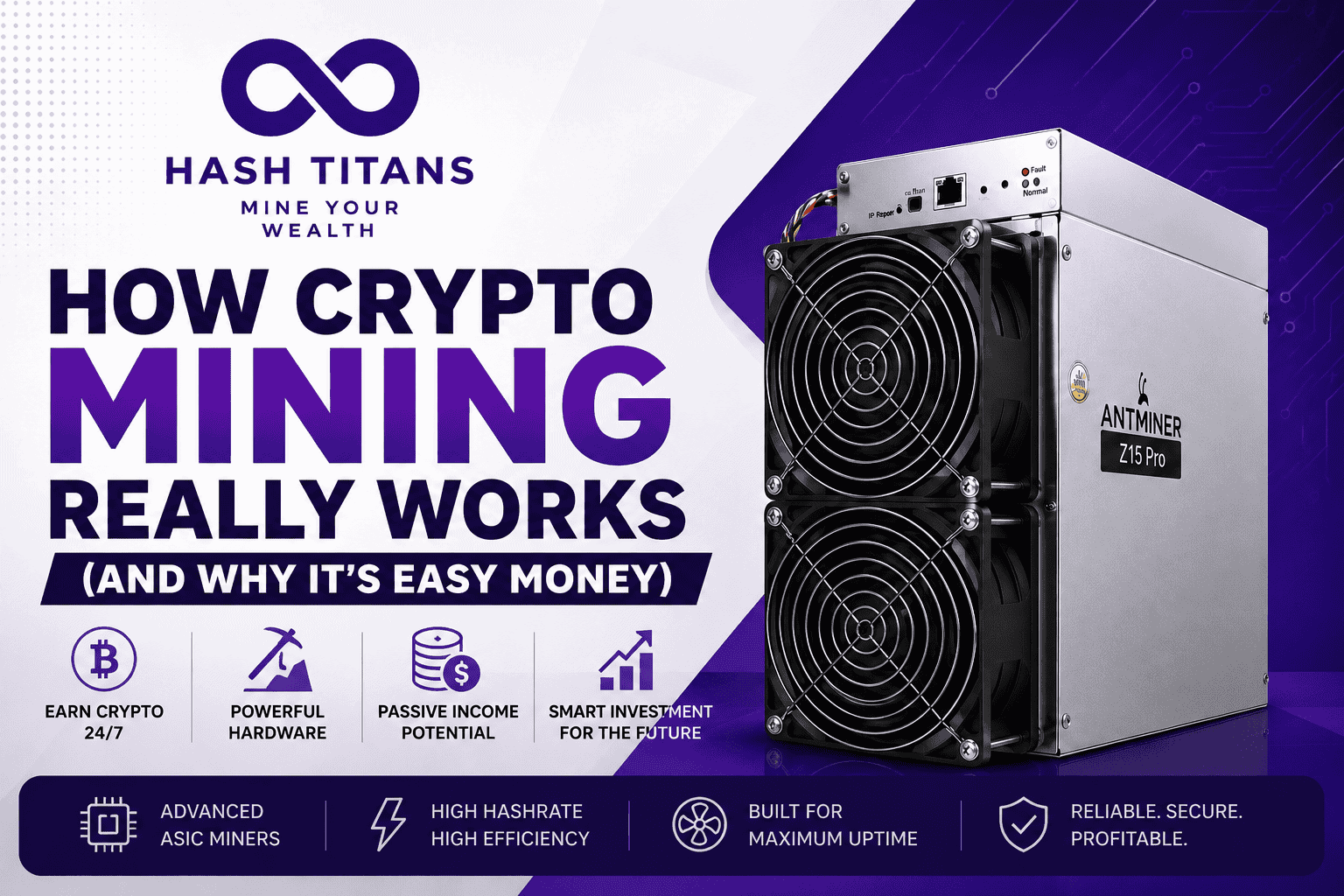
How Crypto Mining Really Works (And Why It’s Easy Money)
Cryptocurrency mining has become one of the most talked-about ways to earn digital assets. Many people hear stories about miners generating passive income and assume it’s easy money. Many beginners start by researching hardware such as the Bitmain Antminer S17 Pro before learning how cryptocurrency mining really works. While mining can be profitable, understanding how crypto mining really works is essential before investing in hardware or electricity.
In this guide, you’ll learn how crypto mining works, the role of ASIC miners, mining pools, profitability factors, and what it takes to succeed in 2026.
What Is Crypto Mining?
Crypto mining is the process of verifying cryptocurrency transactions and adding them to a blockchain. Miners use specialized computers to solve complex cryptographic puzzles that help secure the network.
When a miner successfully validates a block of transactions, they receive a mining reward. This reward usually includes newly created cryptocurrency and transaction fees paid by network users.
Popular cryptocurrencies that use mining include:
- Bitcoin (BTC)
- Litecoin (LTC)
- Dogecoin (DOGE)
- Kaspa (KAS)
- Alephium (ALPH)
Different cryptocurrencies use different mining algorithms. Bitcoin uses the SHA-256 algorithm, while Equihash-based coins can be mined using devices featured in our Antminer Z15 Pro Equihash Mining Guide.
Learn more about Bitcoin’s network at Bitcoin.org.
Mining plays a critical role in maintaining blockchain security, decentralization, and transaction validation.
How Crypto Mining Really Works
The mining process follows several important steps:
1. Transaction Verification
Every cryptocurrency transaction must be verified before being added to the blockchain. Miners confirm that funds are available and that transactions are legitimate.
2. Solving Cryptographic Puzzles
Mining hardware performs billions or even trillions of calculations every second. These calculations help find the correct hash needed to validate a block.
3. Block Creation
Once a valid solution is found, the block is added to the blockchain and becomes a permanent part of the public ledger.
4. Mining Rewards
The successful miner receives a block reward plus transaction fees generated by users on the network.
This process is commonly known as Proof of Work (PoW), which is the consensus mechanism used by Bitcoin and several other cryptocurrencies.
Why People Think Crypto Mining Is Easy Money
The phrase “easy money” often appears in discussions about mining because miners can generate income without actively trading cryptocurrency.
However, successful mining requires:
- Mining hardware
- Reliable internet
- Low electricity costs
- Proper cooling
- Technical knowledge
- Ongoing maintenance
Mining can generate passive income, but it is far from a guaranteed source of profit.
ASIC Mining: The Backbone of Modern Crypto Mining
ASIC stands for Application-Specific Integrated Circuit.
Unlike CPUs and GPUs, ASIC miners are designed for one purpose: mining a specific cryptocurrency algorithm.
For example:
- Bitcoin miners use SHA-256 ASICs
- Litecoin and Dogecoin miners use Scrypt ASICs
- Kaspa miners use KHeavyHash ASICs
Popular KHeavyHash miners include the Antminer KS7, Antminer KS5 Pro, Antminer KS5, and the IceRiver KS5L.
Because they are purpose-built, ASIC miners offer:
Higher Hash Rates
ASIC miners can perform dramatically more calculations than traditional computers.
Better Energy
Efficiency Many miners compare machines such as the IceRiver KS3M, IceRiver KS3L, and IceRiver KS2 Lite when evaluating efficiency and profitability.
Modern ASICs consume less electricity per unit of hash power.
Greater Profit Potential
Higher efficiency often leads to better long-term profitability.
Is Crypto Mining Profitable in 2026?
Crypto mining profitability depends on several key factors.
Hardware Efficiency
For Bitcoin mining, many operators deploy machines such as the WhatsMiner M76, WhatsMiner M70S, and WhatsMiner M66S.
New-generation ASIC miners typically outperform older models by a significant margin.
Electricity Costs
Electricity remains the largest operating expense for most miners.
Cryptocurrency Prices
You can track live cryptocurrency prices using CoinMarketCap.
Higher coin prices generally increase mining revenue.
Network Difficulty
Live Bitcoin network activity and block statistics can be monitored through Mempool Space.
As more miners join the network, mining difficulty increases and rewards become harder to earn.
Mining Pool Performance
The efficiency and fee structure of your mining pool can significantly impact profitability.
Miners with efficient equipment and low electricity rates often have the best chance of generating positive returns.
Mining Pools vs Solo Mining
Most miners today join mining pools instead of mining alone.
Solo Mining
Advantages:
- Full block rewards
- Complete control
Disadvantages:
- Very low chance of finding blocks
- Irregular income
- Higher risk
Mining Pools
Advantages:
- Consistent payouts
- Lower risk
- Predictable income
Disadvantages:
- Pool fees
- Shared rewards
For most beginners, mining pools provide a more reliable path to earning cryptocurrency.
How to Start Crypto Mining
Step 1: Choose a Cryptocurrency
Select a cryptocurrency compatible with your mining goals and budget.
Step 2: Purchase Mining Hardware
Choose an ASIC miner based on the algorithm you plan to mine. Beginners often compare entry-level devices such as the IceRiver KS0, IceRiver KS0 Pro, IceRiver KS0 Ultra, and IceRiver KS1.
Step 3: Set Up a Wallet
Store mining rewards in a secure cryptocurrency wallet.
Step 4: Join a Mining Pool
Pools increase the likelihood of earning consistent rewards.
Step 5: Install Mining Software
Configure software and connect your miner to the network.
Step 6: Monitor Performance
Track hashrate, temperatures, electricity consumption, and profitability.
Environmental Impact of Crypto Mining
Mining consumes substantial amounts of electricity, particularly on Proof of Work networks.
To reduce environmental impact, many miners are adopting:
- Solar energy
- Hydroelectric power
- Wind energy
- Energy-efficient ASIC miners
The industry continues to move toward more sustainable mining practices.
How to Secure Your Mining Earnings
Protecting mining rewards is just as important as earning them.
Best Practices
- Use hardware wallets
- Enable two-factor authentication (2FA)
- Back up private keys
- Avoid phishing scams
- Use strong passwords
Security mistakes can result in permanent loss of cryptocurrency.
Common Crypto Mining Risks
Before investing in mining equipment, understand the risks:
- Cryptocurrency price volatility
- Rising network difficulty
- Hardware failure
- Electricity cost increases
- Regulatory changes
- Security threats
Successful miners carefully manage these risks and regularly evaluate profitability.
Final Verdict: How Crypto Mining Really Works (And Why It’s Easy Money)
Crypto mining works by validating blockchain transactions, securing decentralized networks, and rewarding miners with cryptocurrency.
While many people describe mining as easy money, the reality is more complex. Profitable mining requires the right hardware, affordable electricity, proper maintenance, and a long-term strategy.
For miners who understand the industry and invest wisely, crypto mining can remain a valuable source of income in 2026 and beyond.
Frequently Asked Questions
What is crypto mining?
Crypto mining is the process of validating blockchain transactions and earning cryptocurrency rewards.
Is crypto mining really easy money?
Mining can generate passive income, but it requires hardware investment, electricity, maintenance, and risk management.
What is the best mining hardware?
ASIC miners are generally the most efficient option for mining Bitcoin and many other Proof of Work cryptocurrencies.
Can beginners start mining?
Yes. Many beginners start by joining mining pools and using entry-level ASIC miners.
Is crypto mining profitable in 2026?
Mining can still be profitable if you use efficient equipment, maintain low electricity costs, and monitor profitability carefully.

0 Comments