
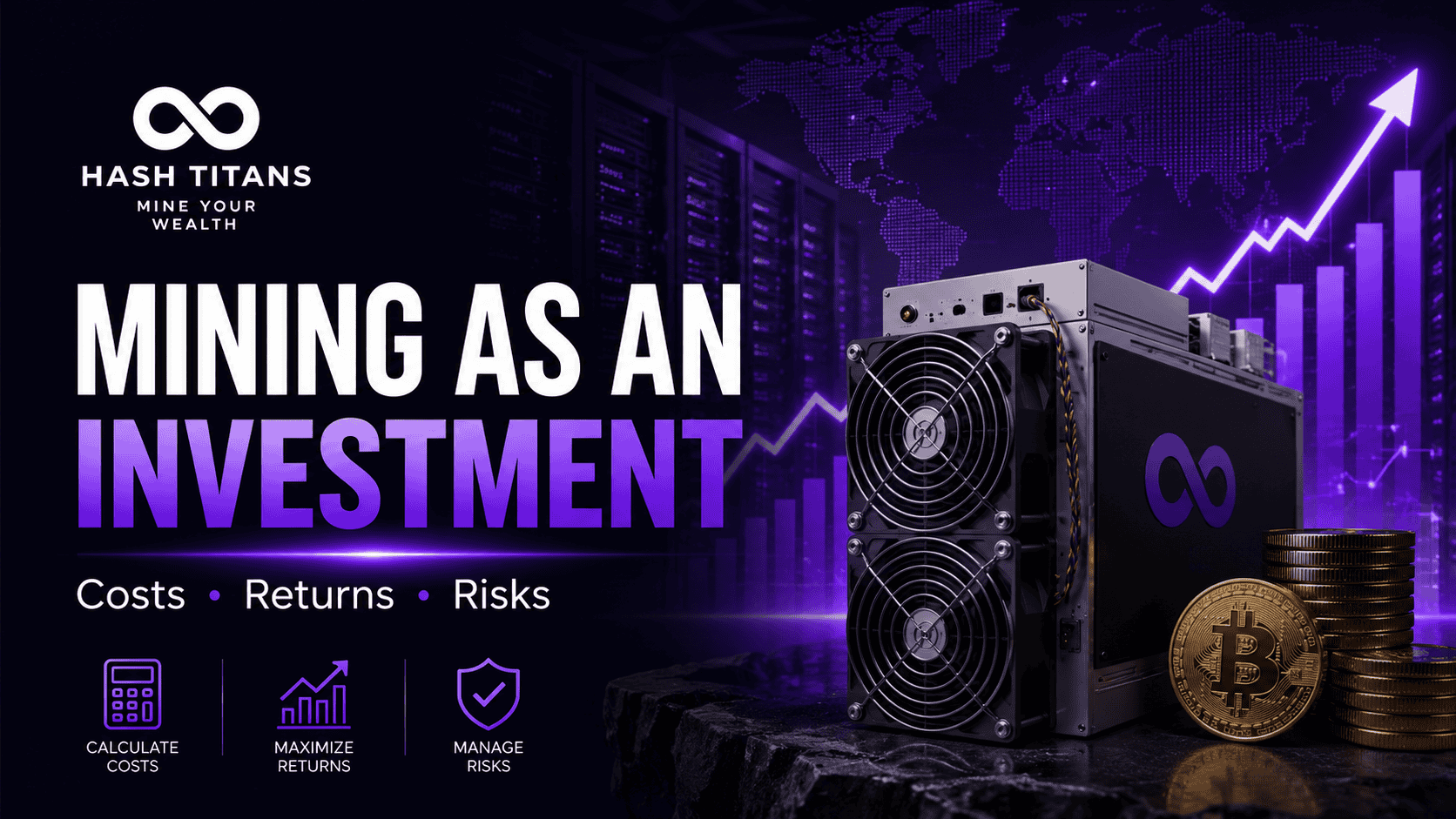

Mining as an Investment: Costs, Returns, Risks and Alternatives
Mining as an Investment can mean buying and operating cryptocurrency-mining equipment, purchasing shares in mining companies or gaining broader market exposure through mining-focused funds. Although these approaches are often discussed together, they involve very different costs, responsibilities and risks.
Direct mining is an operating business built around hardware, electricity, cooling and maintenance. Mining stocks provide ownership in companies that run those operations. Mining-focused funds spread exposure across several companies, while spot Bitcoin products track Bitcoin more directly without producing coins through mining.
This guide examines Mining as an Investment from both an operator’s and an investor’s perspective. It covers equipment costs, electricity, return on investment, mining stocks, exchange-traded products, depreciation, operational risks and the questions to answer before committing capital.
What Does Mining as an Investment Mean?
Mining as an Investment refers to committing money to an activity or asset connected with cryptocurrency mining in the expectation of earning a return. The investment may be direct or indirect.
Direct mining
Direct mining means purchasing ASIC miners and operating them yourself or placing them with a hosting provider. Returns come from mining-pool payouts after electricity, pool fees, maintenance and other costs are deducted.
Mining-company shares
Mining stocks represent ownership in publicly traded companies that operate mining farms. Their share prices may be influenced by Bitcoin prices, mining margins, debt, expansion plans, equipment purchases and management decisions.
Mining-focused funds
Mining-focused exchange-traded products may hold shares in several mining, blockchain or digital-infrastructure businesses. They provide diversification, but investors still face market risk, fund fees and possible concentration in one volatile industry.
Spot Bitcoin products
A spot Bitcoin exchange-traded product generally holds Bitcoin to provide price exposure. It is not a mining investment in the operational sense because it does not purchase ASIC miners or produce new coins.
Separating these routes is important because their return drivers are not identical. Direct mining depends heavily on electricity and equipment efficiency, while spot Bitcoin exposure follows Bitcoin’s market price more closely.
Mining as an Investment Through Direct ASIC Mining
Direct mining is the most hands-on version of Mining as an Investment. The investor becomes an operator responsible for purchasing equipment, supplying power, controlling heat, maintaining uptime and configuring a mining pool.
What direct miners need
- Compatible ASIC mining hardware
- Correct electrical infrastructure
- Affordable and reliable electricity
- Ventilation, hydro cooling or immersion cooling
- Stable Ethernet connectivity
- A mining-pool account
- A compatible cryptocurrency wallet
- Monitoring and maintenance procedures
- Suitable space or a hosting contract
How direct mining produces revenue
ASIC miners repeatedly perform hashing calculations for a supported proof-of-work network. Most small and medium operators connect their machines to a pool, which combines participating hashrate and distributes payouts according to accepted work and the pool’s payment system.
Revenue is not fixed. It changes with network difficulty, block rewards, transaction fees, coin prices, pool performance and machine uptime.
Solo mining versus pool mining
Solo mining gives the successful miner the available block subsidy and transaction fees, but the probability of finding a block can be extremely low for a small operator.
Pool mining normally offers smaller and more frequent payments. Pools charge fees and use different payout models, so operators should compare FPPS, PPS, PPLNS and other available structures.
The Bitcoin Developer mining guide provides additional information about solo and pooled Bitcoin mining.
Mining as an Investment Through Bitcoin Mining Stocks
Mining stocks allow investors to gain exposure to companies operating large mining fleets without personally handling machines, power circuits, cooling or repairs.
These companies may have access to benefits that individual miners cannot easily obtain, including:
- Large-scale electricity agreements
- Bulk hardware purchasing
- Purpose-built data centres
- Professional technical teams
- Access to debt and equity markets
- Demand-response or grid-balancing programs
However, buying a mining stock adds company-specific risks that do not exist when simply holding Bitcoin.
Important mining-stock metrics
| Metric | Why it matters |
|---|---|
| Deployed hashrate | Shows the company’s active mining capacity |
| Fleet efficiency | Indicates electricity required per unit of hashrate |
| Electricity cost | Directly affects gross mining margins |
| Uptime | Shows how consistently the fleet produces revenue |
| Debt | High obligations can increase financial risk |
| Share dilution | New equity issuance can reduce existing ownership percentages |
| Bitcoin holdings | Adds balance-sheet exposure to Bitcoin price movements |
| Capital expenditure | Shows how aggressively the company is expanding or replacing equipment |
| Revenue diversification | May reduce dependence on mining alone |
Why mining stocks can move differently from Bitcoin
A mining company has fixed and variable operating expenses. If Bitcoin rises while electricity and other costs remain stable, margins may expand. Conversely, falling Bitcoin prices or rising difficulty can compress margins even while the machines continue consuming electricity.
Share prices are also affected by management, debt, expansion decisions, securities-market conditions and shareholder dilution. Mining stocks should therefore not be treated as a guaranteed leveraged version of Bitcoin.
Mining Funds and Bitcoin Products
Investors seeking market exposure without selecting individual companies may consider a mining-focused fund or another listed product.
Mining-company funds
A mining-focused fund may hold shares in several miners and related digital infrastructure companies. Diversification reduces reliance on one company, although the entire portfolio may remain sensitive to the same Bitcoin, electricity and regulatory conditions.
Blockchain funds
Broader blockchain funds may combine mining companies with exchanges, semiconductor businesses, software providers and payment companies. Their returns may be less directly connected to mining economics.
Spot Bitcoin exchange-traded products
Spot Bitcoin products provide exposure to Bitcoin’s price without requiring the investor to run mining machines or manage private keys directly. They may charge sponsor or management fees and can trade only during the relevant securities-market hours.
Investors should review the Investor.gov bulletin on Bitcoin and Ether exchange-traded products before purchasing.
Although spot Bitcoin products are sometimes called ETFs in everyday discussion, their legal structure and regulatory treatment may differ from traditional registered investment-company ETFs.
Mining as an Investment Compared With Other Crypto Exposure
| Option | Main return driver | Investor involvement | Major risks |
|---|---|---|---|
| Direct ASIC mining | Mining revenue minus operating costs | High | Electricity, equipment, downtime and difficulty |
| Hosted ASIC mining | Mining revenue minus hosting and other costs | Moderate | Hosting counterparty, contract and equipment risks |
| Mining stocks | Company performance and market valuation | Low to moderate | Debt, dilution, management and operational risks |
| Mining-focused fund | Performance of its portfolio companies | Low | Sector concentration, market risk and fees |
| Spot Bitcoin product | Bitcoin price minus product expenses | Low | Bitcoin volatility, tracking differences and fees |
| Direct Bitcoin ownership | Bitcoin market price | Moderate | Price volatility, custody and platform risk |
The most suitable route depends on whether the investor wants to operate a business, evaluate public companies, obtain diversified sector exposure or follow Bitcoin’s market price more directly.
Mining as an Investment: Profitability Factors
Profitability is the central question in Mining as an Investment, but mining calculators can provide only estimates. Network and market conditions may change before an operator recovers the original purchase cost.
1. Cryptocurrency market price
Mining rewards are normally valued in the mined cryptocurrency. When its market price rises, fiat-denominated revenue may increase. When the price falls, revenue may decline while electricity costs remain unchanged.
2. Network difficulty
Difficulty reflects the amount of work required to find a valid block. Increasing network competition can reduce the expected reward attributable to a fixed amount of hashrate.
3. Block subsidy and transaction fees
Bitcoin miners receive revenue from the block subsidy and qualifying transaction fees. The subsidy decreases at scheduled halving intervals, increasing the importance of efficiency and fee revenue.
4. Electricity cost
Electricity is frequently the largest recurring expense. Two operators using identical machines can have very different results because one pays a lower rate per kilowatt-hour.
5. Equipment efficiency
Efficiency measures how much energy is required to produce a unit of hashrate. For Bitcoin miners it is commonly shown in joules per terahash. Lower J/TH normally indicates better energy efficiency.
6. Uptime
A miner earns no pool revenue while offline. Electrical faults, excess temperature, network interruptions and repairs can reduce real monthly results.
7. Pool fees and payout structure
Pools charge different fees and use different payout systems. Expected revenue should be calculated after pool expenses.
8. Cooling and facility expenses
Fans, pumps, dry coolers, ventilation, rent, security and network equipment increase total operating cost beyond the miner’s stated wall consumption.
ASIC Hardware and Mining as an Investment
ASIC miners are specialised computers designed for a particular hashing algorithm. A SHA-256 miner cannot normally be converted into a Scrypt or KHeavyHash miner through a basic software update.
Hardware specifications to compare
- Supported algorithm
- Rated hashrate
- Wall power consumption
- Energy efficiency
- Input voltage and current
- Air, hydro or immersion cooling
- Noise level
- Operating-temperature range
- Warranty coverage
- Manufacturer and seller reputation
Review specifications using the official Bitmain Antminer specification library or the corresponding documentation from the relevant manufacturer.
Hardware depreciation
ASIC miners are productive assets, but their value can decline rapidly. Depreciation may result from:
- Newer and more efficient hardware
- Higher network difficulty
- Lower cryptocurrency prices
- Changes in electricity prices
- Physical wear and repair history
- Reduced demand for the supported algorithm
- Manufacturer warranty expiry
A machine may continue to operate technically while becoming economically uncompetitive. A realistic investment plan should include residual value and possible replacement costs.
Browse available equipment through the HashTitans ASIC miner shop.
How to Calculate Mining as an Investment ROI
A basic return-on-investment calculation compares the complete initial cost with expected net operating profit.
Calculate the complete startup cost
Include:
- ASIC miner purchase price
- Shipping and cargo insurance
- Import taxes and customs costs
- Electrical installation
- Ventilation or liquid cooling
- Racks, cables and networking
- Hosting deposits or setup fees
- Initial spare parts
Calculate daily electricity use
Use:
Watts ÷ 1,000 × 24 = daily kilowatt-hours
A 3,500W miner uses approximately 84 kWh every 24 hours.
Calculate daily electricity cost
Use:
Daily kWh × electricity price = daily power cost
At $0.08 per kWh, an 84-kWh daily load costs approximately $6.72 per day, excluding cooling and other facility consumption.
Calculate estimated net profit
Deduct electricity, pool fees, hosting, cooling, maintenance and other daily expenses from estimated mining revenue.
Estimate a simple break-even period
Use:
Total startup cost ÷ estimated daily net profit = estimated break-even days
This result is a scenario rather than a guarantee. Revenue, difficulty, equipment value and operating costs can change before break-even is reached.
The Bitmain mining calculator allows users to enter miner price, hashrate, power consumption, electricity rate and other costs when modelling a mining scenario.
9 Major Mining as an Investment Risks
1. Cryptocurrency volatility
The mined asset can lose substantial market value, reducing revenue and the resale value of mining hardware.
2. Network-difficulty growth
More network hashrate can reduce expected output for a machine with unchanged performance.
3. Electricity-price changes
A profitable operation can become unprofitable if the power contract changes.
4. Hardware failure
Hashboards, power supplies, fans, pumps and control boards may fail. Repairs create expenses and reduce uptime.
5. Technological obsolescence
New machines with lower energy consumption per hash can reduce the competitiveness and market value of older miners.
6. Hosting counterparty risk
A hosting company may experience outages, raise fees, restrict access or fail financially. Contracts should explain equipment ownership, insurance, repair procedures and withdrawal rights.
7. Regulatory risk
Mining rules, energy policies, taxation and local operating restrictions may change. Operators should review the laws in every relevant jurisdiction.
8. Mining-stock financial risk
Public miners may take on debt, issue additional shares, make poor acquisitions or purchase equipment at unfavorable prices.
9. Fraud and unrealistic return claims
Guaranteed-profit claims, fake hosting contracts, counterfeit equipment and pressure to pay through irreversible methods are warning signs.
Investor.gov warns investors to be cautious about promises of high returns with little or no risk. Review its investor-protection resources before committing capital.
Mining as an Investment Due-Diligence Checklist
For direct mining
- Confirm the supported algorithm.
- Verify official hashrate, power and efficiency.
- Calculate costs using your actual electricity rate.
- Include cooling and facility consumption.
- Confirm electrical compatibility.
- Request current miner test evidence.
- Review warranty and return terms.
- Calculate shipping, taxes and customs costs.
- Stress-test profitability under lower coin prices.
- Consider future network-difficulty increases.
- Plan repairs and hardware replacement.
For hosted mining
- Verify that you legally own the machine.
- Confirm the hosting rate and additional charges.
- Review contract termination terms.
- Check access, insurance and relocation rights.
- Confirm repair charges and technician availability.
- Request evidence that the facility and machines exist.
For mining stocks
- Review audited financial statements.
- Examine debt and interest obligations.
- Check changes in outstanding share count.
- Compare deployed and planned hashrate.
- Review fleet efficiency and equipment age.
- Understand the company’s electricity agreements.
- Assess management’s capital-allocation record.
For funds and listed Bitcoin products
- Read the prospectus.
- Check management or sponsor fees.
- Understand the underlying holdings.
- Review concentration and tracking risks.
- Confirm brokerage and tax treatment.
- Understand that listed products remain volatile.
Explore ASIC Mining Hardware
Compare available ASIC miners and request purchasing guidance based on your mining algorithm, electricity price and installation requirements.
Mining as an Investment: Final Verdict
Mining as an Investment can provide exposure to cryptocurrency networks through direct operations, hosting, public mining companies or diversified funds. Each route has a different balance of control, complexity, liquidity and risk.
Direct mining may suit operators with affordable power, technical knowledge, appropriate infrastructure and enough capital to absorb equipment failures or market downturns. It should be evaluated as an operating business rather than passive income.
Mining stocks and funds remove physical equipment management but add securities valuation, management, debt, dilution and market risks. Spot Bitcoin products offer more direct Bitcoin price exposure but do not provide ownership of a mining operation.
No option guarantees profit. Use conservative assumptions, avoid investing money you cannot afford to lose and consider qualified financial, legal and tax advice before making a significant commitment.
Mining as an Investment Frequently Asked Questions
Is mining as an investment profitable?
It can be profitable when revenue exceeds electricity, pool, cooling, hosting, repair and equipment costs. Profitability is not guaranteed and changes with cryptocurrency prices and network difficulty.
Is direct mining passive income?
Not completely. Direct mining requires monitoring, maintenance, pool configuration, recordkeeping and management of electricity and cooling.
Is it better to mine Bitcoin or buy Bitcoin?
Mining involves hardware and operating risk but can generate ongoing coin production. Buying Bitcoin provides more direct price exposure without equipment management. The better option depends on costs, expertise and goals.
Are mining stocks the same as Bitcoin?
No. Mining stocks represent ownership in operating companies. Their value is affected by Bitcoin prices as well as management, debt, dilution, electricity costs and fleet performance.
Are mining-focused funds less risky than one mining stock?
Diversification can reduce the effect of one company’s failure, but the fund can still be highly volatile because its holdings may share similar industry risks.
What is the biggest cost in direct ASIC mining?
Electricity is often the largest recurring expense, although hosting, cooling, repairs and equipment depreciation can also be significant.
How long does an ASIC miner take to pay for itself?
There is no fixed period. Divide complete startup cost by estimated net daily profit to model a simple break-even period, then test lower-revenue and higher-difficulty scenarios.
Can a mining investment lose all its value?
Significant losses are possible. Hardware can become uneconomic, companies can fail and crypto-related securities can fall sharply.
Where can I compare ASIC miners?
Visit the HashTitans shop or contact the HashTitans sales team for current models, specifications, availability and shipping information.
0 Comments